
Weighed Goods, PLU Codes and UAE Grocery Platform Gaps
Weighed items, PLU codes, multi-buy offers and fresh markdowns test any retail platform. See what UAE grocery chains should require before they buy.
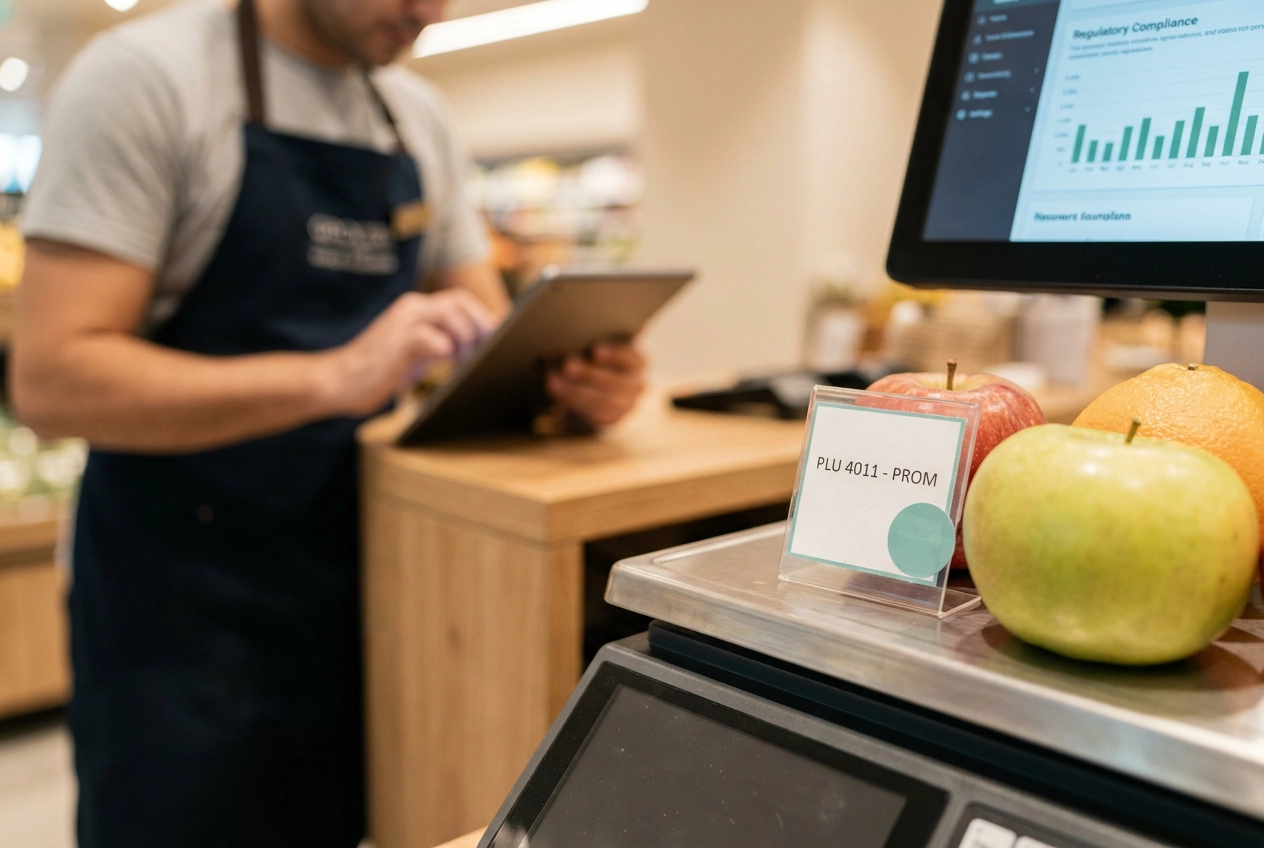
AI-generated header image for: Weighed Goods, PLU Codes and UAE Grocery Platform Gaps
A can of beans is simple. A kilo of tomatoes is not. Food retail is where general-purpose retail platforms meet their limits: variable-weight items, scale integration, PLU codes, multi-buy offers, fresh markdowns, and branch-level price discipline all collide at the point of sale. In the UAE, that collision is sharper. The Ministry of Economy and Tourism has introduced an Essential Goods Prices Platform, retailers need prior approval to raise prices on nine essential food categories, and inspection teams conduct daily monitoring visits. General platforms can process a sale; food retail requires control over master data, promotions, markdowns, and records.
This analysis looks at why food retail exposes those limits. It covers scale integration for weighed goods, PLU master data, multi-buy promotions that behave consistently across branches, fresh markdowns and shrink, the UAE accountability layer for controlled prices and inspection-ready records, questions to ask your retail platform vendor, and how to turn these gaps into requirements before you buy. The goal is not to add features to a checklist. It is to show where margin leaks, compliance risk, and operational drift begin, and what a specialised retail platform must prove before rollout.
Why Food Retail Exposes the Limits of a General-Purpose Retail Platform
Most grocery SKUs sell per unit. Produce, butchery, deli, bakery and bulk goods do not: they sell per kilogram, per 100 grams, or per piece cut to order. These departments drive basket size, and they are precisely where a unit-based item master runs out of vocabulary.
The mismatch is architectural, not a settings problem. A unit-based item carries one price, one stock quantity and a whole-number sale. A variable-weight sale carries a price per kilogram, a decimal quantity and a scale-generated barcode the till must recognise. Configure harder and the model still cannot represent the transaction.
That gap matters more in the UAE. As reported, price increases on nine essential food categories require prior approval, and inspection teams make daily point-of-sale visits. Per-item, per-branch, per-date price and promotion records stop being a reporting nicety, which is one concrete expression of what a single-platform retail ERP architecture actually means.
Test two risks in your own operation rather than assuming them: promotions that resolve differently between branches, and fresh markdowns never recorded. No published source supports a loss figure here, so measure yours.
The sections that follow examine the four capabilities that close the gap: weighed goods and scale integration, PLU master data, multi-buy consistency across branches, and fresh markdowns with shrink visibility. Together they separate a finance system with a till attached from one platform holding one version of the truth.
Weighed Goods and Scale Integration: What Variable Weight Actually Requires
Variable-weight selling requires one continuous loop: price per kilogram is held in the item master, published to scales and label printers, then returned to the till as a scannable barcode. Break that chain at any point and the checkout charges the wrong price, usually without anyone noticing until a customer or an inspector does.
Scale-generated barcodes are not plain EAN-13 values. They embed a PLU plus either net weight or extended price, per GS1's variable measure guidance. A platform that validates only standard GTINs treats these as unknown barcodes.
Stock behaves differently too: kilograms and litres replace eaches. On catch-weight receiving, the platform should compare the supplier's invoiced peso amount against weight actually delivered, post the shortfall and raise the credit note, the kind of reconciliation warehouse features in Business Central are built to handle.
Mid-day changes need stated rules. If the price per kilogram rises at 2pm, do labels printed at 11am still scan at the old price? Tare on containers must be deducted before pricing, and rounding to the nearest fils must not drift across thousands of labels.
Judge the platform on exceptions, not the happy path: refunds of weighed items, manual till overrides, and stock drifting negative because every transaction is a decimal quantity. That is where retail-focused configuration earns its place. The loop also depends on PLU master data, which the next section examines.
PLU Master Data: The Short Code That Decides the Price
The barcode on that scale label resolves to a PLU: a short numeric code, printed on scale labels or keyed at the till, that identifies loose, unbarcoded produce and bulk goods. It substitutes for a GTIN only on items sold without packaging; as produce labelling moves to 2D barcodes, a GTIN is required alongside it. Under Sunrise 2027, POS systems should read both 1D and 2D formats, so treat PLU-only as a transitional state, not a design assumption.
The same PLU, in practice, can drift across suppliers, varieties, grades and countries of origin. No published source quantifies how often this happens, so test it against your own master data. What the platform must provide is one authoritative PLU record, mapped explicitly to item, unit of measure and tax treatment, so a promotion, a margin report and a VAT return all resolve to the same definition.
Ask how a PLU list is created, approved, versioned and distributed. A new item or corrected price must reach every store's scales and tills on the same trading date, not branch by branch over several days.
Attributes decide more than the shelf edge. Organic versus conventional, local versus imported, prepacked versus loose, plus grade and origin, each carry different prices, feed margin by category and substantiate supplier claims.
For controlled categories, where an increase requires prior approval, the record should show who changed the price, when it took effect and what it replaced.
Multi-Buy Promotions That Behave the Same in Every Branch
Clean PLU master data will not protect a margin if the offer attached to that PLU resolves differently at two tills.
A promotion engine should resolve the standard grocery shapes: three for two, two for a fixed price, mix and match across a range, and thresholds that count unit-priced and weighed items in one basket. Adding a 1.2 kg weighed item to a "spend AED 50" threshold is where naïve logic usually stops.
Test consistency directly. Ask a vendor to publish one offer centrally and show it applying identically in every branch, then ask what the system does when a single store holds a local price or promotion override.
Edge cases separate a real engine from a configured one: the same product sold weighed and prepacked, partly qualifying baskets, overlapping offers, and promotions that must exclude controlled categories or items already reduced.
Timing deserves equal scrutiny: start and end timestamps, per-transaction caps, and till behaviour when a branch is offline or overnight replication fails. That is when offers reach customers differently from head office intent.
Discounts should also post with the sale into the same ledger, so finance can compare promotional spend per campaign and per branch against what the till actually gave away. Because consumers are entitled to buy at the declared price, as set out in Federal Law No. 15 of 2020, a branch-level divergence is a compliance question, not only a margin one.
Fresh Markdowns, Shrink and the Cost of Working Outside the System
Multi-buy consistency depends on one more discipline: keeping fresh markdowns inside the same system.
Markdown workflow should name who initiates a reduction on near-date fresh stock, the approval threshold they act within, and the route the new price takes to the label printer and the till. If that route runs on a spreadsheet or a handwritten label, the two can disagree. Under Abu Dhabi's labelling code of practice, date and batch details on a reduced item must not mislead the purchaser.
Date-driven pricing assumes sell-by and use-by dates and batch numbers are held as queryable fields, not printed text. Without structured dates, first-expiry-first-out rotation stays a store habit rather than a system rule.
Known shrink, meaning spoilage, damage, staff consumption and written-off production, is recorded as transactions. Unknown shrink is what vanishes between counts with no explanation. Only the platform separates the two.
Markdowns and write-offs kept outside the platform never reach department margin reporting, so category managers price and reorder on a cost picture that is already wrong. The same disconnect causes stockouts in other retail categories, as this analysis of how a unified retail ERP closes the data gap sets out.
Bakery, deli and butchery sharpen this further: raw ingredients convert into finished saleable items, and yield loss must be recorded where the sale is recorded so the two numbers can be compared.
The UAE Accountability Layer: Controlled Prices and Inspection-Ready Records
Markdowns captured inside the platform matter beyond margin reporting, because in the UAE they sit inside a regulated pricing environment.
As reported, retailers cannot raise prices on nine essential food categories, including cooking oil, eggs, dairy, rice, sugar, poultry, legumes, bread and wheat, without prior approval from the ministry and a national committee. Specialised inspection teams reportedly visit points of sale daily, coordinated across the emirates through a unified national monitoring team, so price and promotion evidence can be requested while the store is trading. MOET has launched an Essential Goods Prices Platform intended to support price transparency and smart shopping; published detail on its features is limited, so treat it as a direction of travel and verify current requirements against the ministry's own materials. Reported strategic reserves of up to six months for essential goods point the same way: procurement and stock visibility matter alongside price control, where manual tracking struggles and a retail-focused system does not.
The implication for platform evaluation is direct. Keep price changes, approvals, promotions and markdowns in one auditable system, keyed to item, branch and effective date, so a review is answered from the system rather than from paperwork. That discipline is the same one the regional e-invoicing wave is pushing, and where master data has drifted it becomes a legacy ERP migration question, not a reporting one. Source detail remains limited; re-verify against ministry materials before publication.
Questions to Put to Your Retail Platform Vendor
Auditability sets the standard; the vendor conversation should be built around demonstrations, not feature lists. Put these questions to any shortlisted platform.
Weighed goods, end to end. Ask for a live, configured demonstration: item set up at a price per kilogram, label printed at a scale, barcode scanned at a till, margin posted correctly, then the same item returned and refunded without a manual journal.
Master data distribution. Ask how PLU and item records reach scales, label printers and tills across every branch, how corrections are rolled out, and what evidence confirms each store received them.
Promotion consistency. Ask to see a mix-and-match multi-buy spanning weighed and unit items, then the identical offer applied in two branches, each with its own audit trail. If one store holds a local override, what does finance see?
Fresh markdowns and shrink. Ask how date-driven discounts, fresh markdowns and write-offs are captured at department level, and how they surface in margin and shrink reporting rather than as a bare stock adjustment.
Integration and architecture. Confirm coverage for scales, label printers, POS terminals and fiscal requirements already in use, and establish whether retail capability sits inside the core ERP or is bolted on separately. For teams assessing Business Central, Business Central Towers: ERP for the Modern Middle East examines how the platform supports operationally complex businesses across Riyadh, Jeddah and Beirut.
If LS Central is on your shortlist, treat these as the evaluation script rather than a feature tour. Index of Solutions implements and supports Microsoft Dynamics 365 Business Central and LS Central, so these scenarios can be run against a retail-focused configuration instead of described on a slide.
Conclusion: Turn These Gaps Into Requirements Before You Buy
This is the point where questions become a document. Before signing, convert the four capability areas into written requirements: weighed goods with scale and label printer integration, one authoritative PLU master, multi-buy promotions that resolve identically across branches, and fresh markdowns with department-level shrink visibility. Requirements left unwritten tend to reappear later as change requests.
Insist on a configured demonstration rather than a slide deck: one weighed item end to end, one mix-and-match promotion run in two branches, and one end-of-day markdown posted to margin. If a scenario cannot be shown on a working configuration, it is not yet a capability you can budget for.
Require auditability by design. Price changes, approvals, promotions and markdowns should be stored against item, branch and effective date, so an inspection request or internal review is answered from the system rather than reconstructed from paperwork.
Fix master data before go-live. No platform compensates for unmanaged PLU records, unclear ownership of price per kilogram, or undocumented branch exceptions.
Finally, price five years honestly, including scale and label printer integration and post-go-live support. Weighed goods and fresh markdowns are where the operating effort, and the cost, actually sits.