
How UAE Fashion Retailers Can End Stockouts with a Unified Retail ERP
See how LS Central's unified retail ERP eliminates the POS-ERP data gap causing stockouts and overselling in UAE fashion retail.
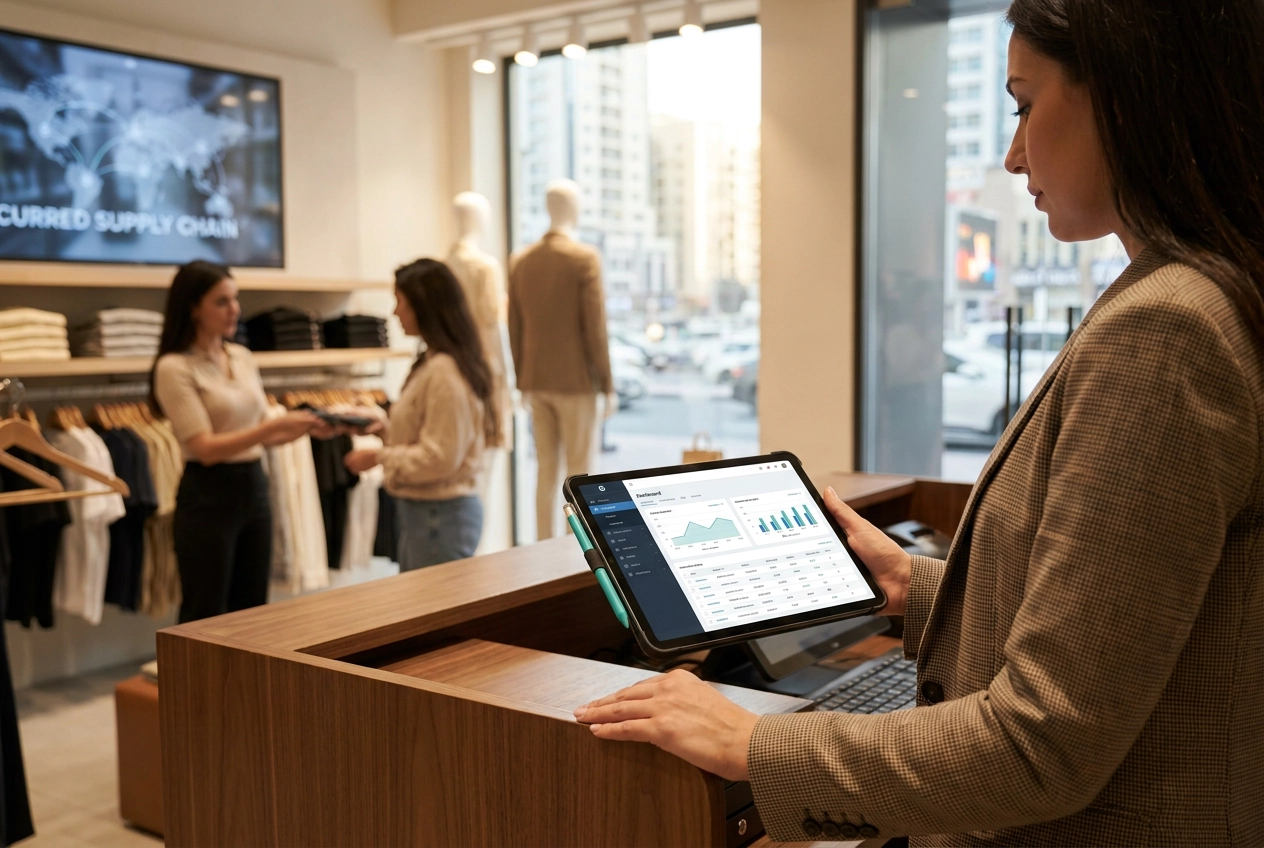
AI-generated header image for: How UAE Fashion Retailers Can End Stockouts with a Unified Retail ERP
Revenue does not always disappear through bad product decisions. In UAE fashion retail, a significant share leaks through the gap between systems that were never built to share data in real time.
When a point-of-sale terminal, a warehouse management tool, and a procurement function each hold a separate version of inventory truth, store staff and buyers are always working from information that is already out of date. That lag is where both stockouts and overselling take root. When available stock is not visible to the people who need to act on it, stockouts follow. When a POS terminal confirms a sale on stock the warehouse has already moved, allocated, or shipped elsewhere, overselling follows.
Markdowns compound the problem further. When buyers place replenishment orders using stale inventory signals, they either over-order lines that are already accumulating in the back of house, or miss reordering lines that are quietly selling through. The result is a markdown cycle that looks like a product selection failure but originates upstream, in the data.
The structural complexity of UAE fashion retail makes this worse. A retailer operating a mall flagship, an outlet store, and an e-commerce channel is managing at least three nodes where inventory data can fragment independently. Each additional location multiplies the reconciliation problem.
The competitive cost of this compounds quietly. Retailers on disconnected systems consistently take longer to recognise a demand shift and act on it. Those running unified platforms respond faster, replenish earlier, and protect margin that others spend recovering. Similar pressures are reshaping retail operations across the region, as explored in this analysis of how modern ERP addresses the challenges facing Saudi retailers.
This analysis examines how a unified retail ERP eliminates that gap entirely. Specifically, it explores how LS Central's single-platform architecture synchronises POS, warehouse, and procurement data to give UAE fashion and apparel retailers the stock visibility needed to prevent stockouts and stop overselling before it damages customer trust.
Across the sections ahead, you will find a clear breakdown of why the problem forms, how the technology resolves it, and what your business should evaluate before committing to implementation.
The Real Cost of Disconnected Inventory in UAE Fashion Retail
Revenue does not always disappear through bad product decisions. In UAE fashion retail, a significant share leaks through the gap between systems that were never built to share data in real time.
When a point-of-sale terminal, a warehouse management tool, and a procurement function each hold a separate version of inventory truth, store staff and buyers are always working from information that is already out of date. That lag is where both stockouts and overselling take root. Stockouts occur when available stock simply is not visible to the people who need to act on it. Overselling occurs when a POS terminal confirms a sale on stock the warehouse has already moved, allocated, or shipped elsewhere.
Markdowns compound the problem further. When buyers place replenishment orders using stale inventory signals, they either over-order lines that are already accumulating in the back of house, or miss reordering lines that are quietly selling through. The result is a markdown cycle that looks like a product selection failure but originates upstream, in the data.
The structural complexity of UAE fashion retail makes this worse. A retailer operating a mall flagship, an outlet store, and an e-commerce channel is managing at least three nodes where inventory data can fragment independently. Each additional location multiplies the reconciliation problem.
The competitive cost of this compounds quietly. Retailers on disconnected systems consistently take longer to recognise a demand shift and act on it. Those running unified platforms respond faster, replenish earlier, and protect margin that others spend recovering. Similar pressures are reshaping retail operations across the region, as explored in this analysis of how modern ERP addresses the challenges facing Saudi retailers.
Why the POS-ERP Data Silo Forms in the First Place
The gap does not appear suddenly. It forms gradually, as a natural consequence of how retail businesses grow.
Most fashion retailers make their first technology investment in a standalone POS system, chosen for checkout speed and ease of use. At that stage, the priority is processing transactions, not managing a supply chain. Finance and warehouse management come later, typically by bolting on a separate ERP once spreadsheets and manual stock counts can no longer keep up.
These two systems were never designed to communicate natively. Synchronisation relies on scheduled batch exports, manual reconciliation, or middleware integrations built to bridge a gap the original vendors never planned to close. Each approach introduces latency and creates new opportunities for error.
In a batch-sync architecture, inventory counts at the POS can lag actual warehouse levels by hours, or longer when sync schedules are deprioritised outside business hours. That delay is the window in which stockouts and overselling occur. A staff member confirms a sale or approves a transfer based on figures that no longer reflect reality.
Fashion retail compounds this problem more than almost any other category. A single garment style can generate many SKUs once sizes, colours, and seasonal variants are counted. As the range grows, so does the surface area of the synchronisation problem. Each additional SKU is another record that can fall out of alignment between systems.
The most visible sign that the architecture advantage, one platform, one truth, is absent is when staff resort to calling the warehouse directly to verify stock before confirming a sale or approving a transfer. That workaround is not a process failure. It is evidence that the retail ERP system is not delivering the real-time visibility the business actually needs.
What a Single-Platform Retail ERP Architecture Actually Means
The problem described in the previous section exists because batch syncs and middleware layers stitch together systems that were never designed to share a database. LS Central takes a different approach at the foundation level.
LS Central is built on Microsoft Dynamics 365 Business Central, with POS, warehouse, buying, and finance functions operating within a single database. There is no separate retail application sending data to a separate ERP system. Every function reads from, and writes to, the same record.
This eliminates the middleware layer entirely. When a sale is processed at a POS terminal, the inventory record updates immediately, and that same record is what the warehouse manager and buyer see at that moment. No export, no reconciliation, no lag.
The distinction between a unified platform and an integrated system is architectural, not cosmetic. An integrated system connects two separate platforms via API. The connection works, but it introduces latency between when a transaction occurs and when other functions see it. It also introduces error-handling requirements and a failure point that must be monitored and maintained. For businesses operating across complex multi-market environments, as explored in our analysis of ERP for the Modern Middle East, that failure point carries real operational weight.
This distinction is most significant during high-velocity periods. During an end-of-season sale or a promotional event, inventory positions change rapidly. Data latency in those windows does not just cause inconvenience; it directly produces the stockouts and overselling that erode margin.
The Three Data Streams LS Central Unifies for Fashion Retailers
That shared data layer operates across three distinct input streams, each of which has traditionally been managed in isolation.
Stream one: real-time POS transactions. Every sale, return, exchange, and discount posts instantly to the central inventory record. No batch process runs overnight; no reconciliation queue builds up. A size 40 dress sold in a Dubai Mall flagship reduces available stock immediately, across every view of that record in the business.
Stream two: warehouse movements. Stock transfers between locations, goods receipts from suppliers, and fulfilment picks all write to the same inventory record the POS terminal is reading from. The warehouse is not maintaining a parallel count that periodically overwrites the store's count; there is one count, updated continuously by whichever operation touches it.
Stream three: buying and procurement signals. Because sales velocity and current stock levels are visible within the same environment the buyer works in, reorder triggers and purchase order generation can be automated against actual demand rather than periodic estimates. For UAE fashion retailers carrying imported collections, this stream carries particular weight. Lead times from international suppliers are long, and a buying error placed on incomplete data is expensive to reverse once a shipment is in transit.
The commercial value of convergence lies in what it eliminates: the information gap between a sale happening and a buyer knowing about it. When all three streams feed the same record, the buyer reviewing a reorder decision and the store manager answering a customer availability question are working from identical data. That alignment is what retail ERP built on a unified platform is designed to deliver, and it is the structural reason stockouts and excess inventory tend to occur simultaneously in disconnected environments.
Stockout and Overselling Prevention: How It Works in Practice
With those three data streams operating on a shared platform, the practical effect on stockouts and overselling becomes direct and measurable.
When a fast-moving SKU drops below a configurable reorder threshold, LS Central triggers a replenishment alert or generates a purchase order automatically. No manual review cycle is required. The threshold is set against live data, so the trigger fires at the right moment rather than after the gap has already opened.
Overselling is prevented at the record level. Because the inventory figure the POS terminal reads is the same record updated by every warehouse movement, a store cannot confirm availability on stock already allocated or transferred elsewhere. The confirmation and the deduction happen within the same data layer, leaving no window for double-selling.
For retailers operating across multiple locations, that visibility allows inter-store transfers to serve as a first-line stockout response. If a size is exhausted at a Dubai Mall flagship but available at a Marina outlet, the system surfaces that position immediately. A transfer request replaces an emergency supplier reorder, which is both faster and cheaper.
LS Central's omnichannel capabilities mean online and in-store channels draw from a single live stock pool, so a product cannot appear available on the website while the shelf is empty.
The reporting layer adds a forward-looking dimension. Sell-through velocity by SKU, location, and time period is available within the retail ERP system, giving buyers the signal to reorder before a stockout costs a sale. For a deeper look at how Dynamics 365 Business Central handles supply chain performance across competing platforms, the analysis covers the operational mechanics in further detail.
LS Central vs Alternative Retail ERP Software: Where It Fits
Understanding where LS Central sits in the broader retail ERP software landscape helps clarify whether it is the right fit before committing to an implementation.
The UAE retail technology market spans a wide capability and cost spectrum. At the enterprise end, platforms like SAP S/4HANA and Oracle NetSuite deliver extensive functionality, but implementation complexity, licensing structures, and customisation requirements typically make them a natural fit for large-scale retail groups with dedicated IT teams and multi-year project budgets. Mid-market fashion brands frequently find the overhead disproportionate to their operational scale.
At the opposite end, lightweight POS-led tools offer fast deployment and low entry costs. What they do not offer is genuine ERP system depth. Managing buying cycles, maintaining supplier relationships, and operating multi-location warehouse workflows require capabilities these platforms were never designed to carry. Selecting one postpones the data silo problem rather than solving it; the fragmentation simply reappears when the business needs more than checkout functionality.
LS Central occupies the space between these two positions deliberately. Its foundation is Microsoft Dynamics 365 Business Central, which delivers real ERP depth across financial management, procurement, and warehouse operations. The LS Retail layer adds fashion-specific POS and retail management within the same deployment, with no separate integration to maintain. Independent reviewer data indicates LS Central is most commonly adopted by mid-size companies and holds a 9.1/10 rating on TrustRadius, where Microsoft Dynamics 365 Business Central scores 8/10.
For mid-market UAE fashion retailers who have outgrown a standalone POS but do not yet need enterprise-grade complexity, this positioning is meaningful.
What UAE Fashion Retailers Should Evaluate Before Implementation
Selecting the right platform matters less than understanding why your current setup is failing. Before evaluating any retail ERP system, map every manual touchpoint between your POS, warehouse, and buying functions. Those manual handoffs are not process quirks; they are the exact failure points a unified system eliminates. If you are unsure where to start, understanding what to evaluate before committing to ERP software is a practical first step before any vendor conversation.
Next, put a number on the problem. Count stockout incidents from your last two trading seasons, calculate the markdown volume taken on overstock that buyers ordered without accurate sell-through data, and add the staff hours spent reconciling inventory across systems each week. That figure is your baseline. It also becomes your ROI benchmark post-implementation.
SKU complexity and location count are the two variables that most directly determine implementation scope and timeline. A fashion retailer carrying three seasonal collections across size-colour matrices at six locations faces materially different configuration requirements than a single-store operation. Be precise about both before requesting any implementation estimate.
When assessing a partner, verify specific LS Central experience in fashion retail, not general ERP delivery. The relevant credentials are hands-on work with seasonal range management, size and colour matrix configuration, and multi-location stock transfer workflows. Generic Microsoft partner status is not sufficient.
Finally, if the business is trading during go-live, plan a phased rollout. Staging by location or function reduces risk without deferring the core benefit: unified inventory visibility from day one of each activated node.
Closing the Gap Between What Sold and What You Knew
Once you have completed the implementation readiness steps outlined above, the underlying conclusion becomes clear: stockouts in UAE fashion retail are not a merchandising failure. They are a data timing failure. The fix is architectural, not operational. No amount of manual process discipline closes a gap that exists because your systems were never designed to share a single source of truth.
That architecture, one shared record for every sale, movement, and reorder, is what makes the difference.
For retailers currently evaluating retail ERP software, this distinction matters more than feature comparisons. The most valuable capability in any unified platform is not the one with the longest specification sheet; it is the one that closes the information gap between a sale happening and a buyer knowing about it. Prioritise platform unification over feature count, and the downstream benefits follow.
Index of Solutions implements LS Central for fashion and apparel retailers across the UAE and the wider Middle East. Our engagement model covers the full deployment lifecycle, from business process design and system configuration through to training and post-go-live support, with direct experience in seasonal range management and multi-location stock workflows specific to the region. As explored in our analysis of why 2026 is a strategic turning point for ERP modernisation across the Middle East, the window for acting on this is narrowing.
Conclusion
The gap between what sold and what your buyer knew about is not a merchandising problem, it is a data timing problem, and a unified retail ERP resolves it at the architectural level.
The key takeaways are clear: data silos cost more than most retailers measure, platform unification outperforms feature accumulation, and the operational case for acting now is stronger than waiting for a better moment.
Index of Solutions can help you map that audit and scope an implementation built around your specific location and range complexity. The information gap is closeable. Start there.